


Problem Statement
Learning English as a Second Language is crucial for communication and group work activities in U.S. classrooms for students with a non-English speaking background. Immigrant children are the fastest-growing segment of the nation’s population of children. Among them, 22 percent of the children were reported to speak a language other than English at home. Namely, around 4 million K12 children from new immigrant families may face the challenge of limited English Proficient. Such rapid demand for LESL requires a shift from traditional to advanced learning methods. This shift is especially important since learners often complain that LESL is difficult, challenging, and stressful(Turgut &Irgin, 2009), especially when it comes to the application of its various skills (e.g. speaking, writing, reading, listening) in real life situations (Akbari, 2015; Hwang, Hsu, Lai, & Hsueh, 2017)
The use of games in general and gamification in particular has been considered to be one of the most prominent instructional methods to motivate students and increase their engagement and motivation during learning processes (see Jackson & McNamara, 2013; Millis, Forsyth, Wallace, Graesser, & Timmins, 2017; Noroozi, McAlister, & Mulder, 2016; Shaffer, 2007). Gamification is considered to be one of the most enjoyable, engaging, and effective method for LESL (Lui, 2014; Munday, 2016; Nahmod, 2017; Perry, 2015; Sundqvist & Wikstrom, 2015). The reason is that various elements (both dynamics and mechanics) embedded in the gamified environments can increase learners’ motivation and interest to learn English (Wu & Huang, 2017), can reduce learners anxiety and fear of speaking a foreign language in front of others (Arnold, 2014), and finally can encourage them to attain a favorable type of learning behavior.
Scientific evidence proves that LESL through games is more effective than non-game learning environments (Zarzycka-Piskorz, 2016). In short, literature suggests that gamification for LESL can be linked to content language learning, engagement, motivation, and satisfaction (see Deterding, Dixon, Khaled, & Nacke, 2011; Deterding, Dixon, et al., 2011; Kapp, 2012; Priebatsch, 2010; Schonfeld, 2010; Werbach, 2014; Werbach & Hunter, 2015)
UP-FRONT
RESEARCH
Online education has increased exponentially in recent years, and many students now learn through Internet-connected devices. This vastly increases the amount of educational data available for analysis. Disciplines such as Learning Analytics (LA) or Educational Data Mining (EDM) study the patterns inside students' interactions to better understand the underlying learning processes. Serious games (and video games in general) are particularly well suited for data analysis. Their highly interactive nature, based on a constant loop of user input followed by game feedback, pose them as rich sources of interaction data. These interactions can be later analyzed to explore how users play, and, in the case of serious games, understand how users learn (Serrano-Laguna, A. et al, 2018).
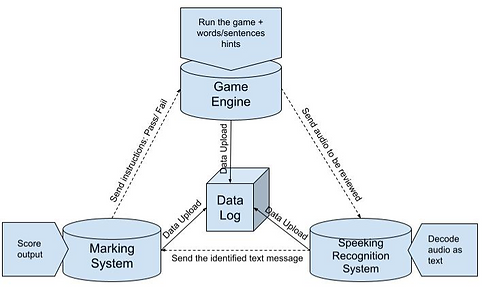
In the game, there are several storylines, and players advance through the game making decisions that affect the overall story and the final result.
Along the way, they will apply their prior knowledge of language to comprehend the story by reading the subtitles at the bottom of the game interface and then orally express their choice according to the previous plots and hints.
The speech recognition system (SRS) will score the oral answer according to word pronunciation, sentence fluency, and the detection of keywords. The game is designed to be completed in 20 to 30 minutes.

STORYLINES
We create three different storylines for the game. Players' decisions will lead them to experience the different plot lines and encounter various English language challenges, which will require them to use different vocabulary, grammar rules, and speaking skills to progress through the game.
To ensure that the game is accessible to a wide range of learners, we include different difficulty levels that cater to different proficiency levels. Beginners can start with simpler challenges, while more advanced learners can tackle more complex language challenges.
Finally, we use data analytics to track player progress and identify areas that need improvement. This allows us to continuously update and improve the game, ensuring that it remains relevant and effective in helping ESL learners improve their English skills.
Overall, our goal is to create an ESL video game that is not only educational but also fun and engaging for learners. By incorporating design thinking principles and gamification elements, we believe that we can create a game that will help ESL learners improve their language skills and enjoy the learning process.


MARKET
ANALYSIS

Our target audience is mainly the K12 children of new immigrants, whose first language is not English. According to the statistics from the Migration Policy Institute (MPI) and the U.S. Census Bureau, there are approximately 44 million immigrants in the United States. More than half of them are originally from non-English speaking countries, the top three are Mexico (24%), India (5.9%) and China (4.9%). In a survey on the English proficiency of immigrants in 2019, approximately 46 percent (20.7 million) of the 44.6 million were Limited English Proficient (LEP). As a result, they are likely to struggle as parents to teach their children English.
Immigrant children are the fastest-growing segment of the nation’s population of children. More than one in four (25.9%), or approximately 18 million children under age 18 today is the child of an immigrant. (Migration Policy Institute, 2021). Among them, 22 percent of the children were reported speaking a language other than English at home. 62 percent spoke Spanish. Other top languages were Chinese (including Mandarin and Cantonese, 5 percent); Tagalog (almost 3 percent); and Vietnamese, Arabic, French (including Cajun), and Korean. Namely, around 4 million K12 children from new immigrant families may face the challenge of limited English Proficient: They do not speak English at home, and their parents have very limited ability to guide them in English learning.

In the future, we will also consider launching our RPG to the international market, and help more ESL learners.
Introduction of Anecventure


